Saturday, December 27, 2008

Chunks Have Returned!

Sam and I work for the same large corporation — albeit in different divisions — and we are both on the Foodies list. In a recent email thread about tempering chocolate and the chips one can buy for the purpose, she casually suggested the new Scharffen Berger chocolate chunks she was snacking on.


My breath caught, and I clicked the link. Could it be? It could.


Because these are not a new product. Scharffen Berger made these chunks a few years ago, but the process was too expensive given the demand. As I remember it, they had to stop their normal chocolate production, switch the factory over to a new mode, and then make chunks for a while before undoing all the effort to make normal chocolate again. I guess all that Hershey money has empowered them to start up again.


You can snack on these, as Sam was doing, or melt them down for tempering, as she suggested. But the baking chunks are perfect in the thick, chewy chocolate chip cookies I prefer. They become gooey pockets in the cakey mass, bigger (and better) than chocolate chips. They are also, it turns out, ideal for the “chocolate things” recipe in The Cheese Board Collective Works (a buttery yeast dough filled with chocolate bits). The recipe even calls for six ounces, which is the exact weight of one package of chocolate chunks.


So far, I've only seen them at the Scharffen Berger stores (at the factory and at the Ferry Building), but you can order them online. Here’s hoping they stay around this time so that I don’t have to go on another hoarding run when I hear they’re being discontinued.

Monday, December 15, 2008

A Diminutive Dinner Party

We have begun to entertain again.


Not, I should add, in earnest. We are rusty at the dinner party game, and so we are swinging our foot along the surface of the water, pushing wavelets about before we jump in.


But nonetheless, some people other than us have sat at our dining room table. Some people other than us have eaten more than a course or two at that table. Some people other than us have sipped our wine.


The other night, we had some friends over. One was celebrating a birthday — like me, she is on some repeat of her 29th birthday — and the others were there to wish her well and catch up. I greeted everyone with a platter of salt-roasted chestnuts, radishes, and balsamic-roasted figs to nibble on while we poured glasses of Champagne.


Regular readers may be about to call me out. I recently claimed that I only peel chestnuts once a year. That’s true, but I have no problem letting my guests peel some, which is the presentation suggested in the original recipe. As it happens, these chestnuts peeled more easily than my tear-wrenching batch, but they still engaged our guests. I like a tactile appetizer platter. There is something immediately leveling and companionable about eating from a common plate, even when the guests are already good friends.


While our guests snacked, I plated a cauliflower panna cotta (mostly the recipe from The French Laundry Cookbook) with a spoonful of gremolata on top and a green salad on the side. I paired it with a 2002 Sherwood House Chardonnay from Long Island because I wanted a wine that was somewhat creamy and weighty with age for the panna cotta but also acidic enough for the salad dressing and gremolata.


Our main course — already we have arrived at the entrée, so you can tell this was casual — was a roast leg of lamb on a rosemary risotto garnished with small dice of root vegetables that had been blanched, shocked, and reheated in duck fat. I pulled a 2002 Ceja Cabernet Sauvignon, a rich, robust wine capable of standing up to the red-rare lamb, from our downstairs rack.


The course I fretted over the most, however, was dessert. Yes, you’re shocked: There was no cheese course. As I said, we are still regaining our stride. I called my dessert “Taste of December.” Eggnog ice cream garnished with nutmeg, pomegranate sorbet topped with ruby-red pomegranate seeds, and spiced cider sorbet, garnished with an apple slice. All served in tuile cups. I was eager to try the freeform sorbet recipes suggested by Harold McGee's The Curious Cook, a recent discovery at a local used book store. He offers proportions for scoopable sorbets of many kinds in tables that promise the ability to create wildly and still score. My first attempt was not exactly what I wanted: Scoopable, yes, but unevenly so, so I couldn’t make perfect little balls. Perhaps some alcohol would have done the trick. I didn’t serve a dessert wine because I feel that frozen desserts blunt the palate and remove the pleasure that a dessert wine can afford.

Tuesday, November 25, 2008

Real-World Wine Pairing

I’m going to use you all as guinea pigs. I want to start posting more about the connections between food and wine. It occurred to me that I have a perfect bag of material: dinner. I don’t cook every night, but even when we get take-out, we almost always have wine or beer to drink.


And since I invest a tiny amount of effort in thinking about that beverage, I thought I’d post occasional glimpses at my thought process.


First, some caveats. I believe that most wine goes with most food. I’ve had a few stellar matches; I’ve had some clunkers. But for the most part, it’s hard to go too far astray. I steer by a few guidelines, but mostly I follow my mood and work with what I have available at the house. Don’t look at these posts as absolute guides; look at them as a glimpse at my thought process. Also, I probably won’t write up every meal. You may have noticed that I’m not so much with the daily posts. But I’ll try to do these with some regularity.


The Dish: Pasta with Roasted Chestnuts and Bitter Greens

Once a year, some recipe inspires me to peel my own chestnuts. Once a year, the chestnuts reduce me to tears with their clinging flesh. This year, the agent of my despair was the recipe for salt-roasted chestnuts in Paula Wolfert’s Slow Mediterranean Cooking (a book I heartily recommend, by the way, despite some editorial lapses). I decided to put her chestnuts onto pasta and mix in wilted arugula and mache.


The Drink: 1997 Stéphane Tissot Vin Jaune, Arbois

I like oxidized wines when I have a strong nut component in a dish. Actually, as my students could tell you, I like oxidized wines with just about anything, and vin jaune is an unusual member of the species. A winery makes it by filling a barrel partway with wine and letting a native population of yeast form a mat on top of the wine. The Arbois region of France, in the Alpine foothills on the east side of the country, is one of the few places where you’ll find a yeast population that can do this: Jerez is another — fino sherries are made this way — and Tokaji is one more, though I’ve never seen a Tokaji Szamorodni here in the United States. Ed describes the flavor of vin jaune as “rancid walnuts,” which is as good a description as any for this funky wine. They age forever: Jack of Fork & Bottle recently let me taste a 1967 Chateau Chalon vin jaune, and it was still fresh and vibrant.


How’d It Work?

Because I so seldom suffer the agony of chestnuts, I forget that they’re more sweet than nutty. I expected the rich flavor of slow-roasted almonds, but I got a delicately sweet nut. The bitter greens mellowed quite a bit, and so the wine ended up overpowering the dish. A gentle, lightly sweet Riesling or Scheurebe might have been a better choice.

Saturday, November 22, 2008

Go To Jojo

Over the years, I have urged my Bay Area readers to go to Jojo in Oakland. Sometimes I’ve done so overtly, but I have always kept a link to it on the right side of this blog. Melissa and I have many happy memories tied to the restaurant and its owners — among others, it’s where we chose to have our rehearsal dinner — and it is simply some of the best food in the East Bay. Curt’s duck confit trumps all the other versions I’ve tried, and I’ve tried many, many versions. And I have always held up their wine list as a paradigm: Not because it’s big, but in fact because it is small, incredibly focused, and closely tied to the restaurant’s food.


We just got word that they’re closing, and it breaks our hearts. They’ve had a good run for a restaurant — nine years — but we still feel like we’ve lost a family member.


So let me urge you, one last time, to go to Jojo before the end of 2008. Don’t miss the chance to experience this rare gem of a restaurant. Don’t be left out when all your foodie friends reminisce about it in years to come.

Thursday, November 20, 2008

Wine Writing Cliches

John McIntyre, whose copyediting blog You Don’t Say is one of the few sites I read every day, has recently been covering cliches. First he discussed crime story cliches, then the seasonal cliches of the winter holidays.


I thought that the wine writing community should join in the fun and point out the clunkers in our field. This isn’t about outright errors, such as using varietal when you mean variety, but phrases we’ve grown tired of reading. Though not ones we’ve grown tired of writing, it would seem. (Just to be clear, I’ve been guilty of these in the past.)


Here are some I thought of. Post your favorites in the comments, and I’ll incorporate some into this post (with attribution, of course).


We believe great wine is made in the vineyard

“At least until we get it to the cellar, where we use a cultivated yeast designed to bring out different flavors; stuff the juice into new, heavily toasted barriques to add a lot of oak; and then use reverse osmosis on it to get the alcohol in balance.” This phrase is practically guaranteed to be on the label of the next midlevel wine you buy. Or on the website. Or in an interview. No one means it: They just want to pander to wine as a lifestyle choice.


pairs perfectly with (or variants)

Really stunning pairings do happen, but far less often than most recipe/wine writers would have you believe. Most wine goes with most food reasonably well. (And as an aside, if you’re going to suggest a wine pairing for a dish, the wine educator in me implores you to explain your choice.)


hedonistic

This Parkerism has spread to much of the wine press, and we have overused it.


rosés aren’t just White Zinfandel

This well-trodden theme about dry rosés crops up every May in what seems like every wine publication. Is there anyone with a passing interest in wine who has not heard this by now? (I assume that those with no interest in wine other than drinking it are not reading the publications that have these articles.)


rascally or rogueish as adjectives for Terry Theise

It’s not that these are incorrect descriptions of Terry, but they seem to always crop up. Reading articles about him begins to feel like reading Homer: “Prudent Penelope” and “clever Odysseus” skitter through The Iliad and The Odyssey. Find new adjectives, or give a richer portrait.


eccentric or maverick as adjectives for Randall Grahm

Ditto for Bonny Doon’s winemaker.


“pop the cork” or “uncork” when referring to anything other than opening a bottle

I often see this as a catchy bon mot — or so the author thinks — in press releases announcing some new product. Too bad that many other PR people used it first.


Katie seconds "we believe great wine is made in the vineyard and adds …


"Fruit bomb" drives me nuts (we can thank the grand poo-bah of wine, Parker, for that one). "Sideways Effect" is another...some of us want to go back to being quiet pinot-obsessed junkies w/o the hoopla!

Wednesday, November 12, 2008

Tete de Cuvee Rose Tasting

As a wine writer, I get invited to a lot of tastings. As a person with a full-time job, I don’t go to all of them. I disregard some, hope to make some — and then can’t — and occasionally find myself at one. Then there are the tastings that get me to take time off so I can attend.


When I got a note from Schramsberg, America’s prestigious sparkling wine maker, inviting me to a tasting between Schramsberg’s wines and comparable wines from around the world, I jumped at the chance. And that was when I expected it to be a small but standard press tasting: Too many people in too small a space, industry friends chattering away while blocking the spit bucket, and a line-up of interesting wines.


When I showed up on Monday morning, after an hour and a half of hungover driving, I was one of nine people in the room, most of whom were in the winemaking business. A line of 12 glasses — it was a blind tasting — had been arrayed in front of each seat. We even had individual spit buckets.


As Hugh Davies, the company’s president, explained, we were there to taste wines from a similar class and see how they fared against each other. He and his staff do this periodically. I had signed up for the Tête de Cuvée Rosé tasting, which meant we were tasting some very nice brands indeed: Bollinger, Cristal, Taittinger, Dom Perignon, and of course the J. Schram sparkling rosés. Most were vintage bottles.


Pencils scratched out notes and glasses went up and down — and sometimes up and down again — as we quietly evaluated these prestigious pink wines. Then we gave our rankings and discussed them.


I consider myself knowledgeable about wine. I have that obsessive geek thing, and I put a lot of research into my articles, which I generally consider to be worthwhile contributions to the wine press. (Indeed, one of those pieces, about efforts to combat urban sprawl in wine regions, had made enough of an impression to get me to this tasting.) But seated among winemaking veterans, I felt like a wine novice. Adjectives poured out, fine points of balance and herbaceousness and bitterness were bandied about, and winemaking techniques were guessed at.


It was fantastic. I love this industry because I’m always learning. I jumped in as best as I could (I will say that I introduced some of them to the term petrichor) and listened to Hugh talk about the sparkling wine industry, his winery’s changes over the years, and more.


As an aside, I always urge students in my wine class to be honest about their opinions, because I can’t tell them what to think. People disagree, and it’s okay. Indeed, wines that I loved came in last place for other tasters. Wines with low marks from me came in first for others, and not always the same ones. And all those tasters disagreed with each other as well. Everyone has a unique palate and sensibility.


Except that there was one clear winner, a complex, well-balanced wine with a rich, fragrant nose and a great taste. As I said to the group, I could have waffled on 2 and 3, and 4,5, and 6 overlapped, and so forth, but number 1 was an easy choice. Most of us put it in the first or second spot. When they pulled off its bag, it was the 2000 J. Schram Rosé.

Saturday, October 25, 2008

The Problem With Cabernet Sauvignon

If you were to gauge our wine tastes by our wine rack, you might think we have an inordinate fondness for Cabernet Sauvignon. When I went downstairs to get a bottle last night, a cursory glance took in a Ceja Cab, a Mondavi, a Silverado, and a Judd’s Hill. And I can only get wines onto the top half of our big wine rack. And one of the shelves is half full of class wines. There were no Rieslings. There were no Sauvignon Blancs. There were no Southern Rhônes. There were no Piemontese wines. And yet these wines are among my favorites.


Why don’t I have any on my rack? Because we drink them all. (We do have a bunch in off-site storage.) But Cabernets sit for a few years before they get pulled out. My abundance of Cabernet doesn’t come from liking it: It comes from never drinking it.


The tannin-heavy, weighty grape has its place, but that place is next to heavy meats, and I just don’t have the budget for steak or rack of lamb every night. Even if I did, I like more variety in my food. To my mind, Cabernet Sauvignon does not.


On the other hand, this means that my Cabs end up sitting on the rack for a while, accruing a few of the years they need to mellow out and develop. Last night, when I made steak for dinner, we drank a 2003 Judd’s Hill Napa Cab, and its fine-grained tannins had settled down to allow the fruit — red raspberry jam and strawberries — to gush out. And there were the first hints of older Cabernet in our glasses: a thin rim of red that was more orange than purple, a whiff of tobacco and earth.


It will probably be a while before I drink another Cab, and so they will continue to pile up. But maybe that’s not such a bad thing, after all.

Sunday, October 19, 2008

Manresa

We may be among the very last Bay Area foodies to eat at Manresa, David Kinch’s well-sung Los Gatos restaurant.


We’ve known about it for a long time: Food bloggers everywhere raved about it even before one of our own started dating the chef. But the last time we thought about going, we bought a new house with a repair list that made Santa Claus’ naughty-and-nice list look like a quick read. We had to wait another year, and our eagerness grew as we read each new glowing report.


We worried that we had heard too much hype. Could the restaurant live up to the gushing praise we had read? Yes, in fact, it could.


In our 15-dish tasting menu, virtually every dish was a little gem: Intense flavors, flawless technique, and elegant presentation. It’s the kind of meal that inspires me, a good cook by most accounts, to improve and stretch my abilities. It wasn’t just good: It was revelatory.


From the starting amuse of red pepper gelée with black olive madeleines (cleverly mirrored with a mignardise of strawberry gelée and chocolate madeleines) to the “Autumn Tidal Pool” (uni and foie gras in a rich broth) to the pork belly with soubise (an onion bechamel) to the banana crème with chocolate fondant and meringue kisses, we had little transcendent moments with each dish. A waiter would describe each course as it appeared at the table, and our anticipation rose to such a pitch that we stopped talking entirely when, after the amuses, a waiter arrived with a basket, which he boldly presented to our adoring eyes as “unsalted butter with sea salt and house made bread.”


One can opt for a wine pairing with the tasting menu, but we decided to pluck bottles from the restaurant’s extensive list. We started with a 2005 Stéphane Tissot Chardonnay from the Arbois, moved to a 2005 Tablas Creek Esprit de Beaucastel Blanc from Paso Robles, and finished with a 2004 Dönnhoff Schlossbockelheimer Kupfergrube Riesling Spätlese from the Nahe (as someone with a high regard for Terry Theise, though, I was sad to see that the wine buyer had opted for a grey market import of this bottle instead of Terry’s). A dinner of white wines might seem odd, but in fact only one course in the menu, the slow-roasted lamb, might have preferred a red wine.


We walked back to our hotel that night, warmed by the company of friends — meriko joined us; I had two dates for the evening — and the memory of the meal we had just eaten. Every so often on that walk home and at breakfast the next morning, one of us would speak the name of a dish from the menu, and we would all take a moment to remember and sigh.


So let us add our voices to the chorus: If by any chance you haven’t already eaten at Manresa, make your reservation as soon as you can.

Sunday, October 12, 2008

Pork Scratchings, A Version Of

What do you do with leftover pig skin?


I recently decided to make my own lardo, salt-cured fatback, using a large piece of pig that my friend Bonnie got for me. Misremembering the details of lardo, I asked for a piece of fat with the skin on.


Bad idea. You want only the fat for lardo, and so I spent hours cutting the creamy white fat away from the pink, leathery skin: I understand now why they used to make footballs from this stuff. With the fat tucked away under weights in the refrigerator, I turned my attention to the square foot or so of skin I had left.


By chance, I had been flipping through Fergus Henderson’s Beyond Nose to Tail. (Also by chance, shuna had been, too.) If you have not yet discovered Henderson, run to the nearest independent bookstore to fix this gap. It’s not just that he writes recipes for offal, the “off cuts” of an animal: He writes those recipes in a warm, humorous, thoughtful voice that is as charming as it is knowledgeable. Of the snails you need for a nettle and snail soup, he writes, “24 fresh English snails, picked by your fair hands (you will need to put them in a bucket and let them poo all their poo out for a few days before cooking …); or there is Tony the Snail Man, who breeds snails.”


One of the first recipes in Beyond Nose to Tail is “Pork Scratchings, A Version Of,” which Henderson describes as “A most steadying nibble.” I describe it as pig skin confit. Pluck stray hairs from the skin; salt it; let it sit for five days; soak overnight in cold water; cook, covered, in duck fat for 2½ hours; and store in duck fat until you need it.


No one considers me shy about serving odd food to guests, but even I might hesitate before serving pig skin confit on toast to most diners. Fortunately, David Lebovitz was in town, and a few food bloggers gathered in San Francisco to pay homage to the master of chocolate and ice cream.


Most food bloggers will put anything edible into their mouths. And sure enough, the guests reached out without hesitation for my crostini, which held reheated, crisped, and chopped pig skin — a gummy, gluey texture — along with an apple-onion marmalade. I watched tentatively as the bloggers’ teeth sank in: I was prepared for disaster. Instead, I heard mmmms and saw eyes rolling back. The pig skin confit was a hit.


I still had some left a week later when I decided to make a variant of the classic French salad of frisée, lardons, and poached egg. Instead of lardons, I reheated the pig skin and chopped it into bits. Instead of frisée, I used Little Gems lettuce tossed in a bacon grease/red wine vinegar vinaigrette. The pig skin bits ranged in texture from teeth-shattering crunchy to teeth-gluing chewy. But they were still delicious. My one regret was that the chunks, even when chopped, glommed together: I wanted them to spread through the salad more.

Thursday, October 9, 2008

Peanut Butter Truffles

I have been on a peanut-butter-and-chocolate kick.


Sitting near our office vending machine hasn’t helped. It is always stocked with at least one Reese’s product: Sticks, Cups, or — for one heavenly week — Pieces. I know these are crap foods, except for Reese’s Pieces, which are wonderful, but they’re close and cheap when I need a snack at work.


But as I chewed my way through these unsatisfying bites, I remembered a peanut-butter-and-chocolate recipe in my cookbook collection: the Peanut Butter Truffles in the back of The French Laundry Cookbook.


As French Laundry recipes go, this one is fairly easy: Make a ganache by puréeing peanut butter, butter, sugar, and melted chocolate; chill; coat in melted chocolate; chill; dust in cocoa powder. It’s also astonishingly delicious. I brought them into work for a “pollinated pairing, ” our team’s occasional Friday celebration of food and drink, and my coworkers slurped them down. Our community manager asked, with hand poised over the plate, if she could take some home and then asked, on Monday, if any were left in the refrigerator. Our group’s designer left early, but I slipped her a truffle before she headed out: She said on the Monday after that it didn’t even make it to the car.


So consider us fans.


I’m not, however, a fan of the truffle dipping fork. I decided to give one of these delicate little forks a try, and I am far from a natural with it. I put the ganache ball into the room temperature chocolate, and then plucked it out with the fork. But the chocolate formed an uneven coat, and if I missed or the fork turned while buried in the chocolate, I ended up plunging the fork into the ganache and turning it into a malformed mess. Only at the end, when I switched to using my fingers, did I get the coating I wanted. I’ve made lots of truffles, but the dipping fork added nothing to the process except frustration.

Thursday, September 25, 2008

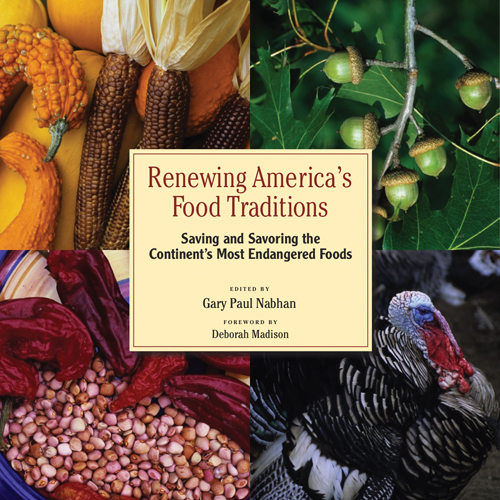
Renewing America's Food Traditions

A casual look around our country’s food supply reveals little more than a mix of sprawling, commercialized monocultures. Plants are grown and animals are raised with an eye to efficiency and profit. The nation’s highways swarm with worker-ant trucks that shuttle our agricultural products 1400 miles, on average, between the farm and the plate.


But take a close look, and you’ll see something different on the edges: The last remnants of America’s native foodstuffs and our pre-factory-farm agriculture. These are foods with real flavor, not the stripped-down blandness of food raised more for shippability than taste. Heritage turkeys have enjoyed the spotlight of the food press, but these are only the beginning if you know where to look.


If you don't know where to look, however, Renewing America’s Food Traditions is a good place to start. The book divides the United States into “food nations” (a practice already in place at Renewing America’s Food Traditions (RAFT) the organization, which birthed the book). A large swatch of California, for instance, is Acorn Nation — a name that rings true to someone like me who learned about acorn grinding holes at summer camp in the Sierra Nevada foothills. Alaska, not surprisingly, is Salmon Nation. The southeastern coast is Crab Nation. And so on. The names evoke the food patterns of the cultures who lived off the native bounty long before semis and trains connected every point in the U.S. with every other point.


Each of the book’s small and well-written vignettes focuses on one particular “heritage” food from the food nation that defines each section, focusing on one or two people deeply involved in preserving that food. Some, such as Honey Drip Cane Sorghum, I had never heard of. Some, such as the Olympia Oyster, are treats that I already seek out. Lovely photos and simple recipes accompany each piece. And — you other research-happy food writers will appreciate this — each two-page essay gives a list of resources where you can learn more about the food.


But not where to buy it. This is my only complaint about this book, which could live on your reference shelf or your coffee table with equal ease. I can understand why there aren’t instructions for poaching leatherback sea turtles. But where do I buy a Silver Fox rabbit?


It could be that the authors don’t want to contribute to the shuttling of food around the country — the editor is locavore founding father Gary Paul Nabhan, after all — but it seems unfair to build up interest in these foods and then snatch away the chance to find them.


But this is a must-have book for any food lover who cares about the more interesting ingredients available throughout our country.


This book was sent to me for review.


Hey all, there’s still room in my upcoming UCB Extension wine class. Sign up soon!

Monday, September 15, 2008

Really Perfect Roast Potatoes

I’ve written about my roast potatoes before, but after making some last night, I thought it was time to resurface the technique. They’re dead simple and super delicious.


Preheat the oven to 425°. Cut waxy fingerling potatoes — say a generous handful per person — into halves or quarters. Chunks of onions make a nice addition. Place on a metal cookie sheet. Sprinkle generously with kosher salt and a woody herb: Rosemary is an obvious choice. Drizzle with a generous helping of olive oil, and use your hands to toss the potatoes with the salt, herbs and oil. Using your hands ensures an even coating. Cook until the cut surfaces of the potatoes are light to dark brown, 20-40 minutes. Don’t stir more than once, as the sides touching the metal sheet will get an extra thick crust if left undisturbed.


Serve with a thick, rare steak. And if you’re going to eat that, you should also serve a luxurious Cabernet Sauvignon or Bordeaux (a blend of Cabernet Sauvignon, Merlot, and Cabernet Franc): The tannins and intense flavors of the wine will stand up to the flavorful meat. I poured a 2002 Volker Eisele Napa Valley Cabernet Sauvignon, and though its fine-grained tannins had softened a bit, the deep fruit and remaining tannins still held their own against the meat.

Wednesday, September 10, 2008

The Genius Of Zuni's Bread Salad

On a recent rare day-off — a short calm before the twin storms of Spore’s launch and the re-release of spore.com — I decided to make a dinner of roast chicken and bread salad. I thought it a spontaneous idea, but any Bay Area foodie knows that it is Zuni Cafe’s most famous dish. And, like many of the restaurant’s biggest hits, the recipe appears in the must-have Zuni Cafe Cookbook.


Judy Rodgers’ detailed bread salad recipe, modified to embrace seasonal ingredients, makes a delicious dish. But that’s not what struck me about it.


The bread salad pairs so well with the chicken because of the texture contrast. Even a good roast chicken has only two textures: tender flesh and crispy skin. The bread salad covers the whole spectrum between soft and crunchy. Her technique has you toast a few big chunks of bread and then tear them into pieces from bite-size to bread crumbs. Then she has you toss your 4 cups of bread with 1/4 cup vinaigrette: a scant amount. The result, as she says, is “a mixture of soft, moist wads, crispy-on-the-outside-but-moist-in-the-middle wads, and a few downright crispy ones.”


Cooking with texture seems like graduate-level cooking technique, but in fact we all know texture combinations that work well: crispy cones with smooth ice cream, crunchy cole slaw with tender barbecue, and crackling crust around creamy risotto in a rice cake. By triggering different sensations, these pairings keep our mouths interested in each bite. Still, it’s one thing to follow established traditions and another to pursue and explore this interplay. I wouldn’t say that I had incorporated texture at a conscious level, but now I plan to and see where it takes me.


Spore has shipped! Our new website is live. That means I may be able to return to life as a writer: I spent today researching an Art of Eating article, and I hope to get back into the blogging habit. Thanks for hanging on.

Saturday, August 23, 2008

Fried Rice Cakes

I still remember the risotto cake.


I ordered it 12 years ago while having lunch with a friend. A golden brown, perfectly shaped hockey puck of warm risotto arrived at our table, resting on a bed of greens. The outside was crunchy and just thick enough; the inside was creamy and melting.


I have chased that memory throughout the years. Even at the time, I made risotto cakes — it’s the best way to use up leftover risotto — but mine were always sloppy and unevenly cooked. That lunch gave me a goal.


And I think, over time, that I have reached that goal. By now, my technique is almost mindless, though it can be derailed by taking away my customary tools. If you find yourself with leftover rice, you should give these a try.


Starting

The easiest rice to use for fried cakes is leftover risotto. The starch that leaches into the cooking liquid makes for a creamy dinner but transforms into glue overnight in the refrigerator. You can shape this rice into cakes without even trying.


But with some extra work, you can even use regular rice. I made a pot of Massa rice last week, and the next night I mixed in an egg and a tablespoon or so of flour: Add enough so that the rice holds together when you squeeze a bit into a ball.


Shaping

One of the turning points in my rice-cake explorations came when I decided to use a circle mold — a round cookie cutter — to shape the patties. Before that moment, my patties still had ragged edges that marred the aesthetics and varying thicknesses that created irregular cooking times. After that moment, I made perfect disks of goodness.


Take a cookie cutter, put it on one edge of a plate, and smush your rice in. Push it into the corners, pack it down, and scrape any extra off the top. Remove the mold, repeat around the plate, and then put the plate in the refrigerator: You want to keep that starch gluey.


Cooking

What better way to reheat buttery, cheese-soaked risotto then frying? You’ll end up with a crusty exterior and a creamy interior, just like that risotto cake I had so many years ago. (You can bread them before frying, but usually I don’t.)


You can use any fat for frying, but I prefer butter. As the butter heats up, I skim the foam off the top to make it semi-clarified. Clarified butter can go to higher temperatures without burning. You want enough butter to come halfway up the cake. Any more and you get a dark band around the middle; any less and you get a light band of cooler rice.


Once the butter reaches the right temperature — a water drop flicked in should sputter loudly — I add the rice cake. I let the butter bubble and pop around the edges until the bottom half has formed a nice crust, and then I gently flip the cake with a spatula. When that half has formed its harder exterior, I pull the cake from the pan and place it on a paper-towel-lined plate to drain for a few minutes.


Serving

A simple salad of crunchy greens is a nice complement to this rich dish. I like to serve this as a light dinner, but smaller rice cakes make for a nice appetizer.


A crisp, aromatic white wine with a bit of weight — an Austrian Riesling, perhaps, or a white Rhône; — is usually my choice for the accompanying drink. The acidity cuts through the fat, while the weight and aromas weather the onslaught of rich flavor. But you would probably do just as well with a lighter red such as a Cru Beaujolais.


Only two or three more weeks until my life returns to what passes for normal around here. Thanks for your patience with the long lags between posts.

Friday, July 18, 2008

UC Berkeley Wine Studies II, Fall

I’m once again teaching Fundamentals of Wine Studies II: Sensory Evaluation of Wines and their Components for UC Berkeley Extension, and I’d love to see some of you in the class. If you’ve ever wanted to see if I can actually babble about wine for 2 1/2 hours, now’s your chance. It starts on October 9 and continues for six weeks. By the end, you’ll have a great vocabulary for articulating what you taste in the glass, and you’ll be able to communicate your likes and dislikes with confidence. The class is less about regions (though some of that sneaks in) and much more about analysis. You can read my detailed description of the classes in earlier posts: Part 1, Part 2, Part 3, and Part 4.


This semester, given that I live and work in the East Bay, I’ve arranged to teach the class in Berkeley. I hope that means that some of you can take it who couldn’t make it into SF in the past. Let me know if you have any questions, and I hope to see you in class.

Sunday, July 13, 2008

Some Recent Food/Wine Books

In March, Alder wrote a vinography.com post titled “Food And Wine Pairing Is Just A Big Scam.” The resulting comment thread surprised me: I didn’t think it was a particularly novel revelation that there’s never one and only one perfect wine for a meal. Some of the best wine writers in the industry — Karen MacNeil and Ed Behr to name two — have been arguing this point for years.


I disagree with Alder’s absolute stance about food and wine pairing — I have some basic guidelines that work well — but I don’t disagree that a major industry has formed around convincing people that they can only pick out a wine for dinner with an expert’s help.


How could I? I’ve been sent three food-and-wine-pairing books for review, and there are probably a dozen others out there. That gives me the chance to compare them instead of doing a full post for each.


He Said Beer, She Said Wine, Calagione & Old

Maybe you can’t judge a book by its cover, but its title is fair game. She’s an urbanely dressed sommelier; he’s a “guy’s guy” brewer. Together, they’re a couple that bickers about what to drink with dinner while maintaining outdated gender stereotypes. There’s even a photo of her standing with crossed arms and her back to him looking at the camera. I guess if they ever make a romantic comedy movie out of the book, they’re all set for the poster shot.


The frustrating thing about this book is that the eye-rolling gimmick hides decent information. It’s nice to see a food-pairing book give equal footing to beer — which in many ways is more food-friendly than wine — though it feels a little wrong that many of the recommended beers come from Calagione’s brewery. The two authors present wine and beer as a series of characteristics that expand your ability to find similar drinks: levels of oak in wine, for instance, and levels of hops in beer. The book encourages its readers to make their own judgment, though only after it has pre-biased them to the results. If someone says a wine smells like lemon zest, you’re likely to smell lemon zest on your next sniff. If a book says beer is the better choice for a dish, are you really going to be objective when you try it yourself?


But the information isn’t worth the cutesy dialog. Pick out a book that’s useful and not condescending. You’re an adult, and you deserve to be treated like one.


What To Drink With What You Eat, Dornenburg & Page

In the year and a half since I first reviewed this book, a mild annoyance of mine has become a full-blown rant: If you just tell a reader which wine goes with which food rather than explain why, you’ve abandoned that reader to ignorance. What To Drink is guilty of that sin, but it’s hard to argue with its voluminous lists, culled from the opinions of sommeliers around the country. If nothing else, it has the potential to introduce readers to new wines (and the book is mostly about wine, though there are other drinks in there) and provide brainstorming opportunities for jaded, cynical wine geeks like myself.


But I find it interesting that while I recommend it — even still — I almost never consult it. So why recommend it? I think the bulky lists offer something, even without an explanation as to why the wines work. They offer a wealth of possibilities and a reassurance that, in fact, there isn’t one wine for any food. There are tons. While it never says so, it underlines my basic food and wine premise: Most wines go with most foods. And that’s a lesson in its own right.


Williams-Sonoma Wine & Food, Joshua Wesson

I don’t look to the Williams-Sonoma books for the kind of cookbook I like. The ones I’ve seen are simple collections of recipes; I look for more technique in my tomes. So I listened politely but skeptically at a book launch party as the executive editor of the series told me how good their food and wine book is.


Then she sent me a copy.


The book organizes its sections by style of wine — Crisp Whites and Juicy Reds, for instance — just like the better modern wine lists. Each section describes the flavors and characteristics of the wine style. It then talks about how those traits affect the wine and food pairing. Finally, it gives several recipes that exemplify the kind of dish that suits the wine. Each of those recipes offers guidelines about the New World and Old World wines to seek out. It doesn’t give specific labels. It gives you terms you could use in a wine store: an Alsace Riesling, a Merlot-based Bordeaux. And for each of those recommendations, it offers a reason.


It educates and illustrates. It lets the reader understand what the author was thinking. What more can I ask for in a wine-and-food-pairing book?

Saturday, June 21, 2008

Until It Looks Right

I was speaking with a friend of mine last week who wanted ideas for a dinner party. She’s in New York now (*sniff*), and she told me what was in season there: She was still seeing lots of springtime produce. I suggested a strawberry-asparagus salad and explained the basic process (blanch 2-inch chunks of asparagus, slice strawberries into wedges, dress with red wine vinaigrette, serve) and then told her I garnished with mint. “How much mint?” she asked. I answered with my normal response to such questions: until it looks right. Get the food to look the way you want, and it will be close to the way you want it to taste.


This insight may be one of the many things my friend Tom taught me. Or we may have arrived there independently. I forget. Certainly, “until it looks right” was a common direction of his.


It’s the rule I use for salads of various kinds and salsa. Probably other dishes as well, but those are the ones where I do it consciously. Come to think of it, I add chocolate chips to cookies until the mix looks right.


Consider my friend’s strawberry-asparagus-mint salad. If you looked at a bite and saw the dark green of minced mint, what would you expect it to taste like? What if you looked at a bite and saw chunks of strawberry and asparagus gilded with little flecks of green?


How you, as a cook, choose the look is up to you, of course.


Tonight I made myself (Melissa is away) a pasta salad with figs, tomatoes, and basil. I added the chopped figs and tomatoes and mixed. I looked in the bowl and saw a sea of creamy yellow pasta with islands of red and purple. I added more figs and tomatoes until there were equals amounts of each color. Then I added minced basil until each bite had 5 or 6 flecks of green, which looked about right. Then I tasted. It needed salt, a little lemon oil, and nothing more: The ingredients were balanced.


Maybe this is obvious: I don’t know. But in my quest to cook from technique and not from a set of instructions, it’s been one of my most valuable guides.


Some other notes on salads that may be helpful as the mercury climbs up the thermometer’s tube. Mix with your hands: You won’t damage the ingredients, and you’ll end up with a better mix. Cut ingredients into similar shapes: Don’t do horizontal slices of strawberries with wands of asparagus. Finally, taste is the final decider: Cooking by look just gets you most of the way there.


Incidentally, I would have loved a figgy Semillon or a crisp rosé with my tomato-fig salad. The Semillon would have complemented the figs in the dish and contributed acidity, while the rosé would have done the same for the tomatoes. But I had a simple Greek red in the refrigerator, so I drank that instead.

Friday, June 20, 2008

Learning To Grill

I remember the first time I tried to grill. I was just learning to cook well — about 13 years ago — and I decided to make a grilled something-or-other as dinner for a friend. I thought I knew the basics of grilling — it’s called cooking over fire, right? — but the flame on my charcoal kept going out. I kept adding lighter fluid.


When you find yourself battling with your girlfriend about whether the food tastes too much like lighter fluid, you’ve already lost the war.


Since then, I’ve learned more about grilling theory: You want an ambient heat, not roaring flames. But I have almost no grilling practice under my belt. Melissa and I have always lived in apartments, and a potential grill has faced the same problem as our smoker: No outdoor space. Not even a tiny deck because, believe me, I’d have used it.


But now we have a modest backyard, and on Memorial Day weekend we took advantage of my one day off and signed ourselves up for Americana 101 by buying our very own grill. I asked meriko what I should buy, and she told me all the things she loved about her large Weber kettle-style grill with the ashcan below, the vent above, and the liftable wings on the grill itself. Other foodies have confirmed that it’s the one to get.


But many have asked why I didn’t get a gas grill. I have a gas stove. If I wanted to cook over gas I would use that. No, I want the experience of hot charcoal, the taste of fire and smoke, and the variable temperature.


Plus, a gas grill is too easy.


If you’ve never learned to grill, how do you give yourself a crash course? I started with Cook’s Illustrated’s How to Grill. (As an aside, of the magazine’s many attempts at repackaging their recipes, I have always liked their first, the diminutive How Tos, the best.) It gave me pointers on fuel (hardwood charcoal), fire starting (use a chimney), getting the heat up, and setting up a grilling environment (high stack of coals on one side for high heat, one layer on the other side for lower heat). Within half an hour, my grill was fired up.


I am by no means a grilling master — our thin, lean porterhouse steaks came out medium instead of the more flavorful rare — but the grill is a permanent fixture now, and, assuming I’ll have a less hectic schedule this summer, we plan to use it often.


Remember me? I used to blog here. I’ve missed writing for OWF, but I’ve been very busy at work. I wasn’t joking about having one day off Memorial Day weekend. If you haven’t done so yet, visit spore.com and see what I’ve been up to. And while I didn’t work on Creature Creator, you should check out the trial version of this truly fascinating toy. You can find my creatures by looking for MaxisPuzzle in our “Sporepedia”.

Saturday, May 24, 2008

Root Beer Floats


On Fridays, my company has a TGIF gathering: They bring in beer and food, and we play the latest video games on the HD television nearby. It’s a descendant of the “beer bashes” that technology companies had in the boom period of the mid-90s, company-sponsored thank-yous for the hard work the staff had put in during the week. Those parties ended as funds dried up in the bust cycle of the late 90s and early 2000s, but Maxis has kept a modest version.


At some point in the past, my new team started its own Friday event. One member of the team brings in a pairing of a beverage — usually alcoholic — and food. This week, I volunteered to bring in root beer floats.


Melissa went shopping for ingredients — I haven’t been getting home in time to make it to the store — and I dug the Glace-A-Tron 6000 from its hiding spot in the basement. Thursday morning, I woke up early to make the custard base; Thursday night, I made the ice cream so that it would firm up overnight.


Everyone loved the throwback to their childhoods: digging spoons into the ice cream and then guzzling down the creamy root beer. Next time, I joked, I’ll make the root beer, too.

Tuesday, May 6, 2008

1998 Michele Chiarlo "Cerequio" Barolo

I planned the meal for five years.


Actually, it only took me an hour or so. We had just bought a bottle of Barolo, the tannic wine of Italy's Piemonte, at a wine shop in La Morra. We knew precisely when we would drink it: April 25, 2008. Though it ended up being April 26. The wine would be 10 years old by then — just about coming into drinkability &mdash and we’d be celebrating our fifth wedding anniversary.


Barolo is the Piedmont’s greatest wine. Osso buco is one of its greatest dishes. I couldn’t resist pairing them: The wine’s tannins and complex flavors could stand up to the braised veal shanks and the risotto milanese I planned to serve with it.


I conveniently forgot that late April can be scorching hot in the Bay Area. After all, it had rained on our wedding day.


So how appropriate that the weather was, once again, all wrong for the plans we had made. Fortunately, our part of Berkeley cools down quickly with the evening breeze off the Bay: Even if it wasn’t the dead of winter, we could enjoy the tender meat, creamy risotto, and rich sauce.


Any time you hoard a truly special bottle of wine, you fret about how it will be when you open it. And it turns out we had good reason to be nervous. At some point in the bottle’s life — presumably before we tucked it into its temperature-and-humidity-controlled storage unit — the cork had pushed out slightly. The cork was also soaking wet.


That’s not a good sign. It suggests that large amounts of oxygen have wormed their way into the bottle, probably ruining it.


But Barolo is a tannic wine, and tannins act as a preservative. Though we prepared for the worst, the wine had a heady aroma of spicy fruit and a rich flavor. It wasn’t perfect, but it was a lot better than it could have been.


A warm day for osso buco and a special wine that went awry. So what went right about our fifth-anniversary dinner? The only thing that really matters: my date. Before we ate, we clinked glasses, and I said, “To five years I wouldn’t have spent any other way.” Melissa and I have eaten together, drunk together, bought a new house together, traveled together, and more in the last 5 years, and I still say today what I said three years ago: She is the person I always want to see on the other side of the table.

Post Slackage

I apologize for the slack in posting. I’m working a lot at my new job, which has not one but two looming deadlines. And Maxis has reawakened my videogame love, since the latest games are my office’s water cooler chatter. (In fact, if you’re on XBox Live, I’m oenoscribe.) So bear with me as I adjust to the new routine, and, as always, thanks for reading.

Saturday, April 19, 2008

Technique: Chicken Rillettes

I often buy a whole chicken for a week’s worth of dinners. The first two meals are easy: something with the legs and then something with the breasts. But what about the wings?


There’s not much meat on them; certainly not enough for a main course. In the past, I’ve picked the meager flesh from the bones and added it to omelettes or soufflés, dishes where you don’t want a big hunk of meat with rich eggs. But for a few recent chickens, I’ve made the wings into rillettes, a spread of shredded meat and fat.


I think I got the idea after making rabbit rillettes from The Zuni Cafe Cookbook. While many books suggest treating rabbit rillettes just like pork rillettes — cook the meat slowly in fat — Rodgers takes a more complicated route that gives the delicate meat a chance to shine: Poach in water with mirepoix and white wine, add a pig’s foot for body, pound in a mortar and pestle, and dribble in fat in tiny amounts.


What had worked so well for rabbit might also work well with chicken, I thought. I modified the recipe — I don’t have pigs’ feet in my freezer on a regular basis, no matter what you think — but the results were still delicious, and the dish has been a recurring favorite.


Except I make them in an ad hoc way. You could argue that Rodgers’ recipe has little in common with my technique, but they share key kinships.


First, salt the wings. Sprinkle a handful of kosher salt onto a plate, press the wings (both sides) into the salt and set them on a dish in the refrigerator for 24 hours or so. The first time I made the dish, I tried to skin the wings: I urge you not to do this; it is time-consuming and ineffective.


The next day, poach the wings in a stick of butter and just enough water to cover them. (If you want to add a little dry white wine or white wine vinegar, please do. If you want to add spices and aromatics, please do.) Cook them at barely a simmer until the meat falls off the bone with even the glancing blow of a fork, about an hour to an hour and a half. Pull the wings from the liquid and let them cool briefly, and remove the liquid from the heat. Using your fingers, strip the bones of the meat and skin and put them into a mortar. Pound the meat with the pestle until it begins to flatten. Now dribble in a tiny bit of the fat from the pot — it will have risen to the top. Pound the meat some more. Dribble in a little more fat, and continue to pound. I probably add two or three teaspoons of fat over five or six doses. You want a spreadable paste of shredded meat, but you also want the flavor front and center: Too much fat will mute it. Season with pepper, smush into a ramekin, cover, and refrigerate. If you won’t use the rillettes that day, you can let the fat continue to cool and then spoon it over the rillettes to seal them in.


Then what? I smear rillettes onto bread or put it into dumplings. Two chicken wings do not yield a lot of rillettes, but two people can get a decent dinner out of them. The other night for a potluck, I smeared a dollop of rillettes and butter onto baguette slices and topped the smear with sliced radishes to make 18 bites of finger food. The rillettes added flavor, while the butter added richness and volume.

Saturday, April 12, 2008

San Francisco Chronicle: Marlborough Sauvignon Blanc At A Crossroads

When Melissa and I visited wineries in Marlborough, I was struck by the number of winemakers who said something along the lines of “Well, Sauvignon Blanc is kind of boring.” or “Sauvy keeps the accountants happy, I guess.” I was also surprised by the wide array of other grapes that wineries were bottling. Other than the occasional Pinot Noir, we rarely see anything other than Sauvignon Blanc here. It struck me that Marlborough has been so successful with the grape that it’s become difficult to get drinkers to buy anything else.


I wrote about these observations for the lead story in the Chronicle’s Wine section. And while you all may have gotten used to these announcements, this article has a special OWF bonus: Melissa took one of the pictures they used for the piece.

Friday, April 11, 2008

Food/Wine Pairing Tasting Notes

Here is a question I often ponder. If you are going to suggest a wine to go with a particular dish (or vice versa), why would you just write a regular tasting note and not reference the dish? That thought crept into my mind again as I noticed this post on Personal Wine Buyer, whose author will be suggesting wine pairings for Design*Sponge. (And I only single him out because I just read his tasting note; I can’t think of the number of times I’ve seen this.)


Here is his write-up of the wine he chose to go with Matt Armendariz’s Sautéed Beet Greens with Sun-Dried Tomatoes and Pancetta:


Beautiful golden straw in color. Not extremely forward or exotic on the aromatics — a bit subdued on the nose. On the palate, this wine shows beautiful grapefruit and citrus, nice apple with some butter and almonds. Really nice minerality with great weight, balance and acidity with a nice crisp finish.

This is a good value at about $18 a bottle — and just a really nice wine. Recommended.

Sounds like a wine I would like. But why, exactly, did he choose it to go with Matt’s dish? It doesn’t matter if you agree with him: Why that wine?


In my wine writing, I try to also be a wine educator. I want people to finish my pieces and think, “Hmm. I learned a little something.” I can and do write adjective-heavy tasting notes, but I don’t kid myself about the number of people who actually read them: very few, I think.


To me, his tasting note and its siblings in the bulk of the wine press are wasted opportunities. The author could have talked about how structure, weight, acidity, and flavor led him down that road. He could have given readers something to think about: a better way to think about wine than as a bag of descriptions. He could have empowered them in the wine shop. What happens when the average reader goes to their local hooch supplier and can’t find the wine? He’s stranded them: They have no way to articulate what they want. Furthermore, he hasn’t given them a language they can use in the future. He has described a wine and failed to give it any context. I, too, have done this in my professional writing. That doesn’t make it right.


Give a man a fish, the saying goes, and feed him for a day. Teach a man to fish, and feed him for a lifetime. As wine writers, we owe it to our readers to teach them to fish.

Two-Part Hominy

As I cleaned out my pantry at the apartment, I rediscovered a small bag of large, dried corn kernels, brown at the tips and expanding into dusky yellow balloons. Melissa quickly spotted their resemblance to Corn Nuts.


But the label on the Rancho Gordo bag said hominy. I had bought it one Saturday on a lark; it beckoned to me, challenging me to discover its charms and challenges. I brought it home, put it in our pantry, stacked some pasta boxes in front of it, and forgot about it. Its rediscovery seven or eight months later prompted a slight frenzy of research as I tried to remind myself what it was and how to cook it.


Hominy is corn that’s been de-hulled by being cooked or soaked in an alkaline solution, a process called nixtamalization. It is the precursor to grits and masa, staples of Southern cuisine and Central American cuisine, respectively.


But I would not be grinding my hominy into grain: I wanted to cook the kernels whole for posole, a stew or soup that showcases the yellow nuggets. You can find posole recipes on the Rancho Gordo site, and from them you can extract a simple cooking technique: Soak the kernels overnight or don’t, but simmer for 3 hours.


First Attempt

The first time I cooked my corn, I skipped the pre-soaking step, though perhaps, “I forgot about it” is more correct. I opened a can of diced tomatoes, sautéed sliced shallots, added the kernels to the pot, and then poured in the liquid from the tomatoes plus enough water to cover the hominy by about an inch. I brought the water to a boil, then reduced it to a simmer for 3 hours. Every half hour or so, I checked the hominy and added water as needed. About 2 hours in, I added the tomatoes and some fresh oregano from our yard. (You can use dried oregano — indeed I rummaged through boxes in vain looking for my bag of Sonoran oregano — in which case you should add it at the beginning of the cooking time.)


Harold McGee, in On Food and Cooking, describes hominy as having a “dense, chewy consistency.” Certainly this first batch did: We exercised our jaws and worked the kernels to the pulpish state we needed before we could swallow. It wasn’t bad, just a lot of work. I imagined adding crispy bits of fried tortilla to create a texture beyond tough.


Second Chance

A week later, I decided to give hominy another try. This time, I remembered chose to soak the kernels for 6 hours before they went into the pot. I used a similar recipe, substituting green garlic for shallots, adding Spanish-style chorizo, and soaking sun-dried tomatoes in boiling water to create both ingredients and cooking liquid.


Melissa and I tentatively took bites, prepared for another chew-a-thon. But the soaking time had softened the kernels and reduced the chewiness to simply pleasant.


Like dried beans, hominy can handle a wide range of stew-y ingredients. You can probably slow-cooker it — I haven’t tried yet — but even without a slow cooker you can leave it simmering gently on your stove as you attend to other things. Just check it periodically in case the water has evaporated. It reheated well the next day for lunch.


Both times I made this, we drank beer with it. Both times, in fact, we drank Cantillon: once the gueuze and once the Rose de Gambrinus. I like the beer, and I figured its body was comparable to the dish’s weight. The acidity would carry the flavor despite the high-acid tomatoes in the dish, and the beer’s strong flavor would still be present despite the chorizo.

Saturday, April 5, 2008

Not About Food: New Job

Since so many of you were so kind with your thoughts and comments about my layoff, I wanted to let you know that after a flurry of interviews and leads, I have accepted an offer for a new job. Technically, I’m jumping the gun a tiny bit, but I’ve got the offer letter in my hands and I plan to sign it.


So barring any disasters, I will be doing server-side work for Spore, the upcoming game from Maxis. If you’re a video gamer, you’ve probably heard of the game. If you’re not, just think of it as the iPhone of video games. The Wikipedia page gives a good overview of the real information and rumors.


I’m super excited to be on the team: I meshed well with everyone I met, and they thought the same of me. The game is slick, the challenges will be really interesting, and my new commute is about 10 minutes by car. And several of my new teammates are serious foodies. (I should note, however, that I will probably have to cut back on my freelance writing for a bit, as I’ll be arriving right at the beginning of the crunch cycle.)


Thank you again for all your kind words (and, in a couple of cases, the leads you sent me).

Monday, March 31, 2008

Judging The American Wine Blog Awards

After Tom Wark announced the finalists for the American Wine Blog Awards, there was a lot of grumbling about who made the cut and who didn’t. This is inevitable; I judge the relevance of any award by the amount of controversy it causes. Few people care that they didn’t get an award they didn’t know about. But as bloggers and their readers grouse, I thought I’d offer my perspective as a judge.


The judging process was straightforward: Anyone could nominate a blog in any of the categories, and when nominations closed, Tom sent each of the judges a spreadsheet with all the nominees. As far as I know, every nominated blog was on the spreadsheet, except for the ones written by the judges and the ones that didn’t meet Tom’s eligibility requirements. Each of the six judges ranked five finalists in each category, and then Tom combined all those to come up with the top four finalists he presented to readers.


My Judging

Judges could use any criteria we wanted for deciding our top five. I gave 50 points for the “so what?” factor, which varied based on the category. For the Single Subject category, for instance, my “so what?” translated into a simple question: If I wanted to learn about your subject, would your blog be a good way to do it? Then I gave 40 points for writing ability: Can the blogger communicate in a logical way? Does s/he demonstrate good knowledge rather than knee-jerk, poorly considered opinions? Finally, I gave 10 points for mechanics: Does the blogger know that it’s and its are separate words? Does s/he drop words from sentences? I gave this little weight in the total because most blogs don’t have copy editors. (For the graphics awards, I just gave a single score.)


I read the front page of entries for each site, and then all the posts from last September — sometimes people beef up their posts at awards time. I took notes on each blog. Brutal notes, too: I summed up one site with “blah blah blah” and another with “who nominated this site?” It didn’t matter if the site’s author was a real-life friend, a social-networking “friend,” or a total stranger. I tried to be as objective as one can be in a subjective context.


Is This The Best We Can Do?

Tom wrote of the finalists, “The collection of finalists … is a stellar example of all the things that are outstanding about the wine blogosphere.” As someone who pored through all the nominees, I had the opposite view: Is this the best we can do? There were one or two categories where I wished I could submit just three finalists, not five. In my scheme, not one site scored above 90 points (though there was at least one 89).


I am guilty of many of the sins I noticed on other blogs. I’m not sure how I would grade OWF if I were looking at it through the objective lens I turned on the WBA nominees. So I used my Web-wide jaunt as a reminder about what I could do to improve this site.


Some of you may find these little discoveries interesting. Some of you may tell me to take a hike (or, you know, some other phrase). That’s fine, because I want to preface these comments with one bit of advice: Write your blog for yourself. Writing for rewards and recognition is a sucker’s game. I have felt the sting of being overlooked for awards, but I finally remembered that I write OWF for my own benefit; my readers seem to keep coming back, so who cares if I don’t have a little badge in my sidebar?


What I Learned From The AWBA Nominees

Context matters. If I want to read page after page of "berries-cherries-flowers" tasting notes and irrelevant scores, I’ll pick up one of the big wine magazines. If I want to read uneducated, fawning press about some new health effect of wine, I’ll turn to newspapers. As bloggers, we can tell our readers why a given wine matters (or doesn’t) and where it fits in the world. We have the ability to talk about how it moves us (or doesn’t). We can wrap news stories in our own opinions and research. We can take a reader farther than the magazines can. We can teach and inform.


Personality matters. As bloggers, we don’t have to adhere to a dry, third-person editorial voice. We can be ourselves. We can use the first-person perspective that few feature wells allow. Of course, too much personality can grate on the reader, but too much is better than none at all. When I read a blog post, I want to get a sense of the person who wrote it. I want to care enough to click on the “About” link at the top of your page. We should let ourselves shine through a bit more.

Writing matters. I’m not a prescriptivist about grammar, despite what you may think. But you don’t need to memorize Strunk & White to communicate ideas in a useful way. Writing is a craft before it’s an art, and almost anyone can learn the craft. Magazines and newspapers have hard-working editors who clean up a writer’s prose: We have to rely on ourselves. I gave some advice about this in an earlier post — and I would add A Writer’s Coach to my list of recommended books — but I think many blogs would benefit from a few hours between writing and posting and one last careful read before the author hits Publish.


We have the opportunity to transform the way people look at wine. Our readers bond with us, learn about our lives, and trust our recommendations in ways most wine writers can’t imagine. We can introduce our readers to something beyond the mass-market bottles and the everyday grapes. We can show them that high quality doesn’t only come from a big magazine.

Friday, March 28, 2008

Relying On Tools

I like to believe, despite the many boxes our friends packed and moved, that I am a minimalist about kitchen gadgets. A good knife, a solid whisk, a handful of wooden spoons, a few bowls, and a couple pots and pans are all a cook needs for most tasks. At least, that’s what I tell myself and anyone who asks.


It turns out that I take my gadgets for granted.


I can finally cook simple food in the kitchen: There are still drop cloths everywhere, but there is now a small work area next to our recently-uncovered refrigerator and stove. I was able to make a simple dinner of pan-seared sausage atop rice that had been cooked in Champagne and beef stock with carrots, celery, and onion.


The problem came the next night.


I had leftover rice, so I decided to fry up rice cakes and serve them atop a simple salad. When I’ve done this before, I’ve puréed some of the rice in my food processor to release the starch left in the grain — this is regular rice, not risotto rice, which hemorrhages starch into its cooking liquid. Where is the food processor? That I know: In an open box. But where are all its parts? I don’t know. I could combat the problem, I figured, by using my other trick: packing the rice into a circle mold. Where are my circle molds? I don’t know. Where is the large spatula I needed to flip the cakes? I don’t know. Where are my whisks so that I could make a vinaigrette? I don’t know: I used the “shake oil and acid in a bowl” approach. Where are my bowls so that I could dress the greens? I don’t know. (Though I did find a ginormous bowl that sufficed.)


I stressed and fumed and ranted as my rice cakes fell apart, all because I couldn’t find the gear that I quietly rely on in the kitchen. Maybe I’m not such a minimalist, after all.

Thursday, March 27, 2008

Dine For A Change, April 3, 2008

On April 3, have a good meal while donating to a worthy cause. Twenty-five Bay Area restaurants and stores will donate a portion of that day’s till to San Francisco Women Against Rape, an organization that educates about sexual assault and helps women who are victims of that horrible trauma. From Bi-Rite Market to our old neighborhood restaurant Pho 84, you have a wide range of options for donating. Take the opportunity to try a new restaurant, or visit an old favorite. Either way, you’ll be doing a good thing.

Saturday, March 22, 2008

Berkeley Bites

Our new house doesn’t have a kitchen. It did when we bought it, but before we moved in we turned that room into a miniature Christo installation, using plastic drop cloths to enshroud every surface while we sand down our smurf-blue walls and ceilings, prime them, and paint them — we’re just beginning to emerge from that process. This has been a glimpse into our lives when we remodel the kitchen in the next few years.


In the meantime, we’ve spent dinnertime exploring the restaurants in our neighborhood. Here are my thoughts on them, but I’d love to hear yours about good, inexpensive spots in our area. (As a related aside, Melissa discovered this sprawling list, a website that predates blogging, of restaurant reviews compiled by a few dedicated souls.)


Breads Of India

Our closest restaurant is a revered spot in this neck of Berkeley’s woods. The ever-changing menu offers a diverse spread of delicious Indian food, but the real treat is the naan. Each day, the restaurant makes four or five different kinds. The menu suggests naan pairings with the main courses. Garlic naan is always on the list, but the others change every day. Each naan is the size of a dinner plate: One naan and one samosa for each of us makes a filling (though not well-balanced) meal.


Picante

This always-busy Mexican restaurant is a popular weeknight stop for us. (And yes, for you purists, its cuisine is more Americanized than authentic.) The food’s good and filling, and the prices are cheap.


Fellini’s

I didn’t have high hopes for our little neighborhood Italian restaurant, especially since they trumpet their “Best Vegan Brunch” award. But they not only use dairy and meat in their non-vegan dishes, the restaurant turned out to be pretty decent. Their steamed kale was intriguing, though I feel like I can make it with more balanced flavors, and the pasta was good. The small wine list featured some esoteric Kermit Lynch bottles, including at least one of his very few Italian imports and his Cuvée Kermit Lynch wine. And Tuesday nights are No Corkage nights, which I support.


Sea Salt

Though the prices prevent this from being an everyday restaurant, it was perfect for Melissa after she spent a grueling day sanding our kitchen walls to prep them for painting. A nice selection of oysters, great seafood, and an excellent wine list make this a top choice, but you pay for what you get.


Barney’s

Every now and then, we get a real craving for Barney’s sloppy hamburgers, only to be disappointed when the reality doesn’t live up to our memory. But when you have only a mild craving, the Bay Area chain cooks up a decent burger.


Lanesplitter Pizza

We rarely ordered pizza to be delivered to our apartment, so ordering from Lanesplitter was sort of a novelty. But the pizza was so-so, and I don’t think we’ll order from them all that often.


Gioia

Gioia, on the other hand, is worth the 5-minute drive to pick up a pie for ourselves. Though the pizza slices were floppier than I might like, the toppings had a deep flavor. (The sausage on ours was from top-flight charcuterie — and friends of OWF — Fatted Calf.)

Wednesday, March 19, 2008

Not About Food: The Other Kind Of Java

On Tuesday, our company’s president came all the way from Chicago to pay us a surprise visit.


Many of you are probably thinking the same thing we all did: Uh oh. And sure enough, headquarters is shutting down our office and laying all of us off at the end of May.


A few of you remember that this has happened to me before. That time, I took a month or so off, cooked a lot, made bread everyday, and generally loafed around. Now, I have a mortgage; my attitude has changed.


I already have a few promising job leads, but I decided to cast my net further out to sea: to all of you, in fact. If you’re hiring senior Java programmers — full-time writing probably isn’t realistic — and you’re in the San Francisco-East Bay area, I’d love to chat with you about a possible fit. Just drop me a line, and I’ll send you my resume. I’m pretty open to possibilities: I’ve worked in very small companies and very large ones in several different domains. I like in-the-trenches programming work that gets problems solved.


And if you’re not hiring, think good thoughts for me. I’m not panicked at all; I’m getting a good severance and I have always kept a large chunk of savings on hand because layoffs are a natural part of the modern-day technology industry. Still, tapping into that reserve isn’t my first choice.

Monday, March 17, 2008

Class Update: Flying Blind/Going On A Blender

The last night of Fundamentals II is always fun. I start the night with a “guess the wine” exercise. As I told my class, being able to deduce a wine from its aromas and flavors is little more than a neat party trick for most people. But focusing on a glass and bringing your experience and memory to bear forces you to think about the wine and take time with it. Too often, we scarf our dinners and gulp our wine: There is value in giving your senses a chance to do their jobs.


I tried to pour wines that were similar but different compared with wines I had poured before. A California Sauvignon Blanc instead of a Sancerre. An Austrian Riesling instead of a German version. After they put forth their thoughts and their guesses, I told them the right answer and told them what could have served as clues. Those grassy, cat pee notes are Sauvignon Blanc, but the riper fruit suggested the New World. The fact that the Riesling wasn’t sweet suggested a country other than Germany. This kind of thing takes practice: As I said, “You’ll be able to impress your friends but your liver will be shot.”


For the second part of the class, I let the students blend their own wines. Rubicon’s winemaker generously donated barrel samples of three Bordeaux varieties: Merlot, Cabernet Sauvignon, and Cabernet Franc. (This was a connection set up a year and a half ago when the class’s former instructor was Rubicon’s estate ambassador.) Each student got a generous pour of each; they had to come up with a blend, explain why they chose the proportions they did, give it a name, and figure out a marketing strategy. Some found that their blends didn’t work well; some found that their blends were great. Some emphasized the fruit character and went for a “drink it now” appeal. Others layered in the tannic Cabernet Sauvignon for a bottle that would age well and develop complexity. They were almost all able to articulate the qualities of the wine they made, in better terms, I think, than they would have used at the beginning of the class.


Finally, of course, I poured the soon-to-be-released 2005 Rubicon Cabernet Sauvignon, a very nice treat from the winemaker. With their own blending experiments fresh in their minds, they appreciated the subtlety, smoothness, and complexity of the official wine.


Because we had talked about botrytis, I poured everyone a little Tokaji Aszu, the famous Hungarian dessert wine, as they filled out their evaluation forms. Even in the last fifteen minutes of the course, I didn’t let up on them: I asked for an explanation for the rich orange color, and someone guessed (correctly) that it was from oxidation. I talked about the puttonyos classification for Tokaji (these days, a measure of residual sugar, but in the past an indicator of the number of baskets — puttonyos — of botrytized grapes that had been poured in to the press) and mentioned Tokaji Eszencia and dry Tokaji.


I always have a mix of sadness and relief when class ends. The class is a lot of work, but you can’t spend six nights with the same group of people without feeling closer to them. I know what people like, where they shop, and their favorite foods. They know my preferences and quirks, and they were all excited to hear that I would have the Wine section’s lead story the Friday after class ended.


Best of all, I can hear in their comments that they are more confident about their wine knowledge. They now talk about balance, complexity, oak, tannins, brettanomyces, and more.

Friday, March 14, 2008

SF Chronicle: Vineyard Nurseries

If you’ve already seen the lead story in the Chronicle’s Wine section, I know what you must be thinking: “Geez, Derrick, how cliched can you get? A story about vineyard nurseries?”


No, wait. I’m thinking of a different topic. In fact, the small-but-crucial nursery industry rarely gets coverage in the consumer press; I’m not sure how much coverage it gets in the trade press. But just about any vine you see in a vineyard comes from one of the handful of nurseries in the state, and lots of their stock comes from a small department at UC Davis.


I guess I have a thing for geeky wine topics — reverse osmosis, barrel alternatives, heritage cabernet clones — and I eagerly said yes when my editor asked if I wanted to cover this topic. I got a more in-depth look at how vineyards get vines, and I hope I conveyed that to the readers (by the way, be sure to check out the pictures as well). Along the way, I realized, more than ever, that plants are just crazy weird. You lop them into bits, glue them onto some other plant, and they start growing just like normal. Weird.

Wednesday, March 12, 2008

Book Review: A Geography Of Oysters

I consider myself pretty oyster savvy, but the other night I looked at a restaurant’s oyster selection with new eyes. The names gave me clues they hadn’t before, and I had enough knowledge to comment on the presence of Olympias and Belons (these from Maine, I think), both unusual fare.


The secret to my new awareness? Rowan Jacobsen’s A Geography Of Oysters, an exhaustive look at the North American oyster industry. (Like all modern books, it has a companion website; unlike most such sites, this one is deep and useful.) Rowan was the managing editor at The Art of Eating for a time, but this is such a good reference that I have to recommend it, even though our former working relationship straddles my “know too well to review” line.


Rowan has that Art of Eating passion for extensive research. You will learn about the life cycle of an oyster, the history of oyster cultivation, and the many different farming techniques. And that’s all before he gives you a detailed tour of oyster regions, breaking them down further into the individual oysters that come from them. You’ll learn that a Malpeque can come from anywhere on Prince Edwards Island, while a Colville Bay comes from one tiny point. You’ll learn that the original Wellfleets and Bluepoints no longer exist: Each has been replaced by oyster seed brought from somewhere else. His detailed surveys include taste profiles of each different oyster type. And, of course, he has practical information for the oyster shopper, from shucking to recipes.


As good as the information is, the writing is the pearl in its shell. Rowan is one of the writers I look to as a model; he has a knack for colorful prose with a snappy tone and wit. Of life as an adult oyster, he writes, “You find a nice spot, settle into the lotus posture, and do nothing but eat, breathe, and periodically blow off a third of your body mass in one titanic ejaculation.” He ponders the use of the word terroir in reference to an oyster’s unparalleled ability to reflect its environment, writing, “Terroir, after all, refers to terra firma, and oysters’ terra isn’t very firma. But it’s a term already familiar to most readers, and speaking of meroir would get you laughed out of most restaurants …” It’s rare to find such pretty prose, and I feel like sending snippets to all the crappy writers out there.


Oysters are the ultimate foodie food; A Geography Of Oysters is the ultimate guide to them.

Monday, March 10, 2008

Class Update: A Night Of Terroir!

I started class the other night by asking how many of my students had heard the term terroir: Most had. Then I asked them what it meant, and the room quieted down. Tentatively, they began to mention the definitions they had heard while I scribbled them on the board. “Of the earth.” “The effects of soil on the vine.” “That a wine tastes like where it came from.” And so on.


As I told them, there’s no right answer. What, exactly, defines terroir is one of the most-debated topics in the ivory tower of wine geekdom. I gave them Matt Kramer’s clever definition — somewhereness — and my favorite description — a sense of place. I told them that some people say it’s whatever nature gives to the grape, but I have a more inclusive description: I don’t feel that you can separate the culture so easily. The way a vintner trains a vine. The traditional mindsets about winemaking. A Bordeaux must taste the way it does in part because the English were such a strong market for hundreds of years.


So how do you teach something that has no definition? You pour a lot of wine and talk about the factors that shaped each one.


I started the class by pouring a traditional Chablis (which is made with Chardonnay) and a rich, though unoaked, California Chardonnay. The descriptions overlapped to some extent (lemon zest, for instance) but the California Chardonnay evoked tropical fruits and had a heavy weight, while the Chablis prompted descriptions of stones and seemed more acidic. That, I told them, was the broadest stroke of terroir. Here in California, we get hot temperatures that saturate the grapes with fruit flavors and lower the acid. In Chablis, the cold temperatures and chalky soil tend to produce leaner wines with less fruit and more minerals.


After that, I poured a Sancerre and a Pouilly-Fumé. The two villages practically face each other across the Loire river, and both white wines are made with Sauvignon Blanc. The wines were similar, my students decided, but they did call out differences. This is terroir on a smaller scale and still, to some extent, in broad strokes. Sancerre has more south-facing slopes, but the chalky soil and steep slope drain water away from the thirsty vines, yielding more acidity despite the greater sun exposure. Pouilly-Fumé is flatter, and the flinty soil can leave a taste in the wine (though not in this one). (As a digression, we talked about Fumé Blanc, the California term, coined by Robert Mondavi, for Sauvignon Blanc made in a Loire-esque style.)


Next, I poured three Premier Cru Burgundies from 2005: Morot’s Cent-Vignes and his Toussaints and Xavier Monnot’s Toussaints. This is terroir at a more intimate level: different vineyards within a single region. Oftentimes in this class, students pick the vineyard bottlings as more similar than the ones from the same producer, but most of the class called the two Morots as the most similar. That didn’t exactly make a good illustration of the Burgundian fascination with terroir, but I would have sided with them: The Morots had more extraction and heavier flavors.


We closed the night with two Spätlese Rieslings from Kerpen in the Mosel. Same ripeness level, same region, but, again, different vineyards close by each other (and, I believe, on the same side of the river.) We talked about the differences and how the Mosel, along with Burgundy, is one of the few places where terroir is at its most obvious.


This week, we’ll be talking about blending and blind tasting.

Friday, March 7, 2008

Beer Glasses (Not Goggles), SF Chronicle

Delve into wine even a little bit, and you'll quickly discover the fetishistic appreciation of glassware. Crystal companies have made serious bank convincing the world that it needs a different wine glass for every style of wine, a marketing message that I find dubious at best, as it often reeks of pseudoscience.


But the wine world has nothing on the beer world, where it sometimes seems like every beer has a unique glass. I dug into that world a little bit for an article in today’s Chronicle. The subject is far richer than anyone can fit into 800 words, but I had a great time researching the history of beer glasses. (And related subjects: I found an interesting journal article arguing that George Ravenscroft at best funded lead crystal and didn’t develop it himself.)


For those who enjoy systems as much as I do, I found a couple of guides to beer glass shapes while working on this: one at beeradvocate.com and another at johnsgrocery.com, which is also a good retail source for esoteric glassware.

Friday, February 29, 2008

Class Update

I meant to provide weekly “behind the podium” updates from my wine class, but the move to the house consumed a lot of time. Instead, I'll catch you all up on the last few weeks.


Class 2: Your Nose Knows

This class is a lot of work for the teacher, but I know — as someone who took this class several years ago — that it gives the students good tools for identifying aromas in wines. I spent the afternoon chopping a wide range of ingredients and putting them in little Dixie cups with foil covers. Lemon wedges, lemon zest, canned peas, liver, salumi, bacon, steak, chalk, and many more — I think I ended up with 70 samples. I write the name of the ingredient on the bottom of the cup. Students sniff the cup, try to guess the aroma, and then check their answer on the bottom of the cup. For those aromas that are limited to white or red wines, I put the sample into a cup and pour in a neutral white or red wine. It’s easy to recall an aroma when a person says its name — if I say, “vanilla,” you can probably conjure up its odor — but much harder to go from an aroma to its name. This is one of the hardest parts about articulating what’s in a glass, and of course the subject of infinite amusement to non-connoisseurs. “Flutter of Edam and soupçon of asparagus,” indeed.


As I told my students, I’m of two minds about the push to standardize wine descriptions (perhaps best personified by Dr. Ann Noble’s Aroma Wheel). On one hand, I encourage my students to develop their own tasting vocabularies: This helps them remember wines and draws from their own experience. On the other hand, a standard vocabulary allows you to read someone else’s tasting note and make sense of it, and it allows you to articulate something meaningful to a sommelier or wine merchant.


Either way, you have to train yourself to map scents to names, and this exercise gives students a chance to start that re-education. After we smelled the samples — a chaotic flow of cups around the room — I poured a number of aromatic and typical wines and asked for descriptions. Starting from that moment, my class couldn’t get away with “citrus” or “berry” as descriptions: They had to drill down and tell me which citrus and which berry. They had to tell me if a wine smells more like citrus zest or the fruit as a whole. (The other night, one student said a wine smelled like shoe polish, and another one quipped, “brown shoe polish,” which gave the class a good laugh.)


Class 3: Faults And Flaws

“Next week,” I told them at the end of the second class, “we’ll be smelling all sorts of stinky wines.” Hardly a good sales tactic. But I think this class is one of the most educational for one main reason: I scrounge up corked bottles from local wine shops, and then I pour (hopefully) uncorked glasses of the same wine. (Because of a cold, I couldn’t smell that night, and I passed around a “good” bottle that was corked as well, which everyone thought was amusing.) Naturally, I talked about how cork taint gets into a bottle, alternate closures, what to do when you get a corked bottle at a restaurant, and so forth.


I also poured samples of flaws that might not be flaws in the right context. A brown color and nutty aroma — signs of oxidation — are flaws in a recent Chardonnay but features of oloroso sherry. A hint of nail polish is a flaw in most wines, but not in an Amarone or Valpolicella. Brettanomyces, the yeast that gives wines a leathery, sweaty, “barnyard” aroma, is a flaw to a UC Davis graduate but not to a vigneron in the Southern Rhône or Burgundy.


Class 4: Oak

From a shopping perspective, this is probably the hardest class in the entire course. I went to the store and asked for wines with varying oak profiles: neutral, lots of American, lots of French, light toast, heavy toast. This isn’t how wine merchants categorize their inventory, so they had to do some thinking. But I found a good selection.


In my lecture, I tried to emphasize that oak is analogous to spice in cooking. You can overdo it, but a little can add complexity to a wine. I talked about barrels (and printed out my article on barrel alternatives) and the different variables that could affect the wine: the wood, the toasting, the size, and the age. I talked about New World versus Old World philosophies (more oak versus less, to paint in broad strokes) and increasing shifts to an “international” palate, which tends to have more oak character.


Rather than give the students a list of oak aromas — there are tons — I told them to look for umami scents — toasted bread, caramel, molasses, soy, chocolate, coffee — and different types of spices and nuts. The class called out descriptions and I wrote them down, and then we talked about which aromas were from the oak. By the end, I think they had a good sense of whether a wine had seen a lot of oak or if it was well-integrated: They could describe wines as oaky or not even before they knew what had happened to it in the cellar. (I pour the wines blind.)